Saturday, April 6, 2013

Who is the bad one?

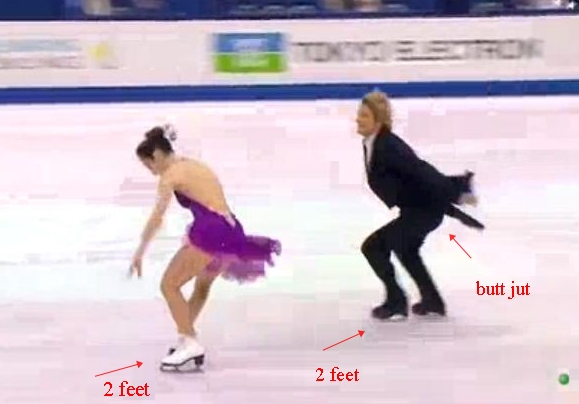
The next 2-3 posts are self-indulgent because I started out screen capping two footed examples but ended up with a gazillion jpgs because they're always on two feet in this program. And then I'd see some random WTF and gif it.

Tarasova thinks this program ought to have won. I don't know what this program IS. More than anything else they skated, this program is hot air. It falls apart completely when you do the breakdown.

One thing is now clear. Meryl and Charlie cannot transition out of their elements with skating skills, nor can they transition with skating skills period. At all. They skated a few segments of this program - a few short, one-note segments - but they do not do even elementary segment transitions on an edge. Why not? 

They do have edges, but they don't stay on them. More notably, they don't USE them for anything. The only time we see Meryl and Charlie's edges is when they have to show them to the judges. After that, they don't skate with them. And they're two time World champions.

Alrighty then.

After I get this 3 or so post vent out (gifs and jpgs); I'll take a gif breather and then I'll look at this year's World Championship winning free dance to see how much Meryl and Charlie have grown.


Her toe pick is not meant to be on the ice - she repeats this move elsewhere in the program where it's both on and off the ice. Here, she never got it off the ice.


And why is Charlie looking at the ground.


Just wondering

This post started out as speculation in a comment section but then I thought - why not throw it out there.

The comment section observed that Skate Canada has consistently and persistently explained why Patrick Chan deserves to win per the ISU rulebook. Skate Canada has spelled out that no other man has Patrick's combination of skating skills and quad jumps that conform precisely to the CoP criteria, and that's just life. The other guys don't have this this and that.

We're not left to think "skating skills" is some type of prettiness or swoony dreaminess - it's a complex set of skills and Patrick's capabilities are in another realm in this way, that way and the other way. CoP has to give him the points - he's racking them up according to CoP's own system almost every instant he's on the ice.

But we hear nothing from Skate Canada about why Virtue and Moir, if CoP is to be a legitimate judging system, also are just about unbeatable no matter what the "other teams" bring to the playing field. There's nobody else who does this, that and this. So suck it up. (I always feel that slight complacent toolish edge from Skate Canada whenever they "explain" something, but notwithstanding, I agree.)

But then I remembered the past two Canadian championships, and thought - what if Skate Canada is hoping to use DW tactics to make winners of GP? That would explain a LOT. It would explain why Skate Canada doesn't do for Virtue Moir what it does for Patrick Chan. Slipchuk repeatedly lays out the case for Chan in CoP-centric language.

The case for Virtue and Moir is beyond easy to spell out - for Skate Canada to make the case in CoP-centric language, skating skills language, bladework language.

Don't even say 'D&W'. Just say "other teams" or "no other team can" and then hit the bullet points and connect it to the rules.

But if they were hoping to get G&P scored with D&W glasses, they won't do that. They'll not only let VM swing, they'll pull the chair out, like they did 2 Canadians in a row.

It seems to me the agenda of the past two Canadians was to strip points from VM - just like the ISU judges are apt to do, and then pile on the points for G&P to create the impression G&P weren't that far off from championship form. It wouldn't serve SC's agenda to remind us what good ice dancing actually looks like, specifically, to break down what high level skills require. Something has to explain why they put VM under a microscope or pretended to, but let Piper practically fall down in the midline without impacting the points.

This DW exercise is becoming more and more horrifying. I started out thinking about the overscoring they've been getting since 2009-2010. And this season it reached a tipping point. I'd never noticed they did only two twizzles until it came up on Aunt Joyce's blog and he said the two twizzles they do are level 4 so they don't have to do three sets. I parked that info in the back of my head to look at later - I was curious what elevated the level of those twizzles. There's been a bunch of stuff about DW I'd meant to look at more closely, and the purpose of this project when it started was to demonstrate that VM were clearly the stronger team, with better speed and power, more blade run, better partnering and cleaner elements, and that the stuff people assumed DW had over them was accomplished with a lot of theatricality instead of actual speed and power.

BUT. I never expected to find what I'm actually finding when the programs are deconstructed. FYI - deconstructed just means - look at what they are actually doing, and compare it to what they're awarded for doing.

What we have here might be the first ice dance world champions who neither dance nor figure skate.

I've got a dance spin gif from Die Fleudermaus that I'm trying to troubleshoot before I upload it. It's in slow mo and focuses on something in the dance spin entry. Mother of God.

Friday, April 5, 2013

Positions

I've just finished reading a portion of FSU's virtue moir thread. As ever with figure skating discussion they're focused on positions.

Unlike what fsu seems to believe, screen caps of what Meryl looks like in lifts versus what Tessa looks like in lifts isn't a case of "pretty versus sloppy" or "but Virtue and Moir's lift is different than that lift!"

The screen caps aren't showing posing. They're a freeze frame of an athlete in action and they help reveal how well the athlete is executing the element, not how pretty they look during it.

One fan in particular is "defending" how Meryl looks because she apparently believes there is no connection between how Meryl looks in a lift and how well she is executing the lift, and she also seems to think that if Meryl looks strained during something it must mean it's pretty darn hard. It looks hard!

The screen cap in question shows that Charlie is hanging onto Meryl's hand with his hand and she's clutching onto his arm/shoulder with the hand that is closest to his body, and her legs are bent and sloppy. That's not just an unpretty position. That's sloppy execution. Do fans even know the difference?

Tessa isn't better than Meryl because she points her freaking toes. She's better because she's doing more difficult elements and her mechanics are better, her technique is better. Tessa's "toe point", alignment and the extension she carries through her entire body is a consequence of quantifiable things like her ability to balance herself in an element and then get out of the element. It's her mastery of dissociative movement. It is far far more difficult - in ways pointedly relevant to the sport they're in - to execute as Tessa does than to execute as Meryl does.

Meryl doesn't look sloppy in lifts because they're "hard". In fact, the lifts she and Charlie do are not as hard as Virtue Moir's, for reasons illustrated below and that will be illustrated further. She looks sloppy in lifts because she is not using good technique even though the element itself is easier. She's clutching onto Charlie. She is not controlling her extremities in space.

"Position" is not synonymous with fucking "ornament" or "pose".* Combined with the mechanics of your movement, your position is the outcome of your freaking TECHNIQUE.

And yet the discussion there is - well that's really tricky to do so of course Meryl is going to look a little rough because she's doing something super hard!

NO.

1 - what she's doing isn't as difficult as what Tessa's doing.

2 - she looks rough because she's not doing it well or properly. She doesn't have the truncal control, the dissociative mechanics (mastery of dissociative movement is all about core stability),  the balance, the ability to orient her body with her core - i.e., her head, shoulders, arms and hands.

3 - do fans know that doing something badly is easier than doing it well? That doing it well with good alignment, good control - i.e., "prettier" is harder than doing it with an unstable core so you end up clutching onto your partner somehow and you can't maintain core stability AND extend your legs so you are just "screw it" with extending your legs? That doing something badly is a symptom of less good figure skating?

4 - that if you have extraordinary core stability you can not only execute the move itself but you can do so with all of your limbs extended and aligned so that when you exit out of the move your body is in optimal position to get onto a balanced edge, which is what you want to do cause, you know - figure skating?

But that most of all, acquiring and then working with that degree of core stability is very very very very DIFFICULT?

Because going by the stuff a lot of fans say, they don't.

5 - why don't people ever check to see how hard something is before jumping into the fray. Why is it always "that LOOKS hard". Yes, making a conspicuous show of apparent difficulty is what DW are all about, but if someone is a fan of the sport as a sport, and not a simply a fan of ice dancing despite it being a sport, then why not find out if something IS actually hard, relative not to whether you can do it, but whether it should be hard for a world championship calibre ice dancer to execute - verus what the main competition is demonstrating.

Position isn't ornament. Position isn't posing. Position is form follows function. Tessa's body is functioning properly in the lift, she's moving efficiently, she's executing optimally, and that's why her form is good.

Meryl doing it sloppily and out of alignment is actually much much easier than what Tessa is doing. What Tessa does isn't down to her doing a different lift. It's down to her being a better ice dancer. Every time Meryl's body goes out of alignment, every time she's clinging to Charlie with both hands to keep herself balanced or in order to transition, she is making the movement EASIER.*

*Unless we're talking about one of the very very many "pose lifts" Davis White indulge in to get themselves from point a to point b, which ARE all about the pose, because that's all Meryl is doing in them - a static pose while Charlie is behind her in a squat, lifting her a short distance off the ice. Pose lifts are ornamental. So naturally Davis White do tons.

________________________
*Caveat: if Meryl were in Tessa's condition, had Tessa's training, had Tessa's stable core, then it would be easier to do it well than to do it poorly, because doing something well always = the most efficient, "best" way to accomplish something, so that's always going to be "easier".  The hard part of that, though? Setting yourself up to be Tessa in the first place. Acquiring her conditioning, her spatial awareness, her equilibrium, her range of motion, her stability, her POOF. It's very very very very very hard work. Lots of training, because the human body isn't naturally set up to do what she does.

If you haven't set yourself up to be like Tessa, or if your body just won't cooperate/refuses to work like that no matter how you train, then if you try to extend yourself out on a perpendicular on one of Scott's shoulders during a rotational lift, you're going to roll right the fuck off. Or you're going to have to get your hands involved and help out your core by hanging on for dear life. Maybe not do the perpendicular, maybe go across his chest so there's not so much you and space. So if you're not Tessa, then yes, it is easier to do it like Meryl, because if you don't do it like Meryl, you're not going to be able to do it at all.

The hard part is becoming Tessa. If you can do that, it gets easier.

Thursday, April 4, 2013

Belated Happy Easter From the Bunny's Best Friends, Meryl and Charlie

Die Fleudermaus placeholder (gif clips to be are on the tarmac).


It was tough to figure the Die Fleudermaus placeholder. The constant, gratuitous two-footing? The constant running and skipping? Or the incredible weirdness that keeps showing up with Meryl in entrances to rotationals - in the Giselle twizzles and here, in the lead up to the spins.

They have the sloppiest feet - EVER. Whether on an edge (both of them, not just one of them) or not. But both on an edge is the exception.

But it's spring, so hopping it is. Although in Die Fleudermaus, it's all about the two footing. That will be for gifs, with some screen cap illustration.

P.S. - elsewhere, I mentioned that this team only skates in segments. They don't link the segments with skating. It's hopping, squatting and other tricks, but mostly two-footing. So much two footing. Re-watching, what's actually taking place is that they re-set before and after elements.

Always. They can't take the momentum into the next thing - not on edges they can't. They can't even stay connected. It's get away from me, and I need to get off any kind of edge.

The smiling, hopping, waving, looking out to the audience and WTF-ing is meant to disguise that they've in fact, stopped skating and are re-setting.

Before I started this project - which I didn't know was going to become a project when it began - my expectation about Meryl/Charlie is that they were indeed, "good element skaters" (as Scott Moir has said) but their basic skating was nowhere near as refined as Virtue and Moir, nor was their speed, blade run or ice coverage what was claimed.

I didn't realize that they do little real skating of any kind in their programs. They're freaking ice dancers, for God's sake.

I didn't expect to see that the elements weren't anything to write home about, and in fact, pretty basic compared to Virtue and Moir's. Of course they can go after the element with a lot of attack, as one would expect after practicing relative basics for five years. It will be interesting to see if other ice dancers give this a shot. A lot of dancers at the moment are really going for levels. Forget that. Find your comfort zone. And then drill the shit out of it over the summer til you can execute in your comfort zone in your sleep, and condition yourself so you can just blow through them. It doesn't matter HOW you blow through them. Just do it. Your pcs will grow and it's just a lot easier this way, and whatever you're doing will get the levels just because you're the ones doing it. You'll become the rulebook.

Davis White's elements - not just their skating - their elements are nothing to write home about divorced from the visual trickery in which they're cloaked.

But the thing is - I understand that if you're watching Meryl Charlie you see a lot of what looks like spinning, flying, sailing, dancing - that's how you take it in.  All this visual noise is set really well to the music - the music is never subtle, so if Meryl is doing something odd like scrambling her feet before a spin, or Charlie has his feet planted for the umpteenth time - you just don't notice.

But all you have to do is load the program up on some type of editing program and go - okay, I'm going to cut after the first ten seconds. So you've got the first ten seconds of the program and you see how little is really there and what a lot of to do the both of them are making out of presenting this nothing. Then you do the next ten seconds, and it's more visual junkyard stuff. Then the next, and already they've skidded to a re-set on two feet. Basically, deconstructed this way - and it was the case with both Giselle and Die Fleudermaus - you're waiting for the actual program to start - and it doesn't. This IS the skating. It's actually not buried that deeply - this little ten second excerise shows it up right away. Yet the judges are watching this in both the short and long program year after year, at practices and in competition, and haven't noticed it? The pcs have gone up for Meryl and Charlie.

The Halls of Academe

 Figure skating has not been researched as extensively as other subjects, but the academic world has apparently done a hell of a lot more research than the sport itself has cared to try.

This paper:

bio mechanics of figure skating plus a few correlations with dance and track

was written in 1997 by physicians/researchers who specialize in spine technology and (very often) sports rehab.

Some of the stuff that struck me:

Maria Mountain of Revolution Conditioning without question understands everything in this paper and more, as do Scott and Tessa, so one wonders how she manages a straight face watching Davis White - if she does.

That hour long warm-up Patrick Chan does, that we've seen repeated in various Chan profiles - is historically something figure skaters don't do but it's likely his most important take away from working with Christy Krall - more than his quad mechanics. His body and his career will be thanking her for years.

And -

wonderful ballet (or any dance) technique is more than beautiful (static) lines and rhythm, no matter how elegantly extended your lines or how exquisite your toe point. It's also about:
Disassociate movement. Balanced movement using neutral spine mechanics.  ....Today, dissociative movement is appreciated as a ballerina performs balanced leaps and pirouettes with movements of her extremities in patterns that are disassociated from movement of the spine.
Disciplined disassociate movement is desirable. It's efficient, it's stabilizing, it concentrates the potential of a movement, even outside figure skating, such as in great track and field athletes. It's part of the highest quality of figure skating - skaters who master dissociative movement  are able to maintain the

quiet, isolated upper body required for the technical and difficult maneuvers performed in competitive figure skating.
 

When I picture elite ice dancers who demonstrate exquisite disassociate movement, it isn't a pair of skaters who concertedly keep their upper bodies constantly in motion, constantly busy, able only to hit a pose but not work their blades or their stroking/crossovers with quiet, isolated upper bodies, that's for sure. If quiet, isolated upper bodies are required for the technical and difficult maneuvers performed by elite competitive figure skaters, that certainly explains the other sort of maneuvers Davis White favor. It doesn't explain the points they receive for them, however.

Probably since 1997 that whole dissociative movement thing became unimportant, because the actual mechanics of quality figure skating have become unimportant, at least in contemporary ice dance, which is, of course, the most logical figure skating discipline where slop should be rewarded. Someone better best tell Tessa.

Tessa's good at something else which apparently nobody's told her is archaic in present day ice dance:
Position of optimal function (POOF - not kidding, that's the acronym).
Tessa being the best POOF skater in the world allows her to accomplish a rotational lift laid out perpendicular on one of Scott's shoulders, sustaining textbook alignment and stillness with her lower extremities in space, through multiple rotations and to smoothly and swiftly re-orient upon the lift exit into a running edge.

I've also learned that that single axel we see Tessa executing in that tumblr gif is textbook with perfect mechanics - during rotation her axis is over her landing leg, the revolution completes in the air, upon landing her hips and shoulders are square to the landing leg to control the landing edge and run it out, and her free leg hip is elevated to achieve the ideal aesthetic position.

And finally, this:
Stroking. The purpose of stroking and crossovers is to generate speed.
Who knew? Skaters are supposed to generate speed with stroking and crossovers, not leaping, jumping, hopping, skipping, yanking, pushing and running.

But this paper was published in 1997. Doubtless, standards have changed.

Wednesday, April 3, 2013

Deep inside edge.


She's still on it - how come?


So she can flow out of Scott's arms on her own into a running outside edge.


Exact same points as DW.

You know that old saying - Got to be twice as good to be treated equally. Here it is in ice dance.